From Kolkata Skewers to the Three-Part Kati Roll
The commonly repeated origin story begins in 1930s Kolkata. A kebab vendor wrapped skewer-roasted meat in paratha, giving busy customers a portable meal that could be eaten without plates or cutlery. Early versions used iron skewers; the name kati, linked to the Bengali word for stick, became associated with the later use of lighter bamboo skewers.
The broad history is clear, though surviving accounts do not establish one uncontested invention date. The more useful legacy sits inside the roll itself.
The Paratha-Char-Acid Test
A convincing kati roll depends on three elements:
- Sturdy, flaky bread that bends without tearing under meat juices and chutney.
- Hard-seared filling with the browned edges expected from skewer-roasted kebabs.
- Sharp condiments that cut the combined richness of chicken fat and layered paratha.
For one roll, a practical target is a 20–23 cm paratha, 110–130 g cooked filling, 15–20 g thick chutney, and 20–30 g pickled onion. Those proportions keep the roll generous while leaving enough bare bread to close it tightly.
A home cook can build the same street-eats contrast without a tandoor. Cast iron supplies direct-contact browning, while pickled onion and herb chutney keep each bite lively rather than heavy.
Choose a Paratha That Can Carry the Filling
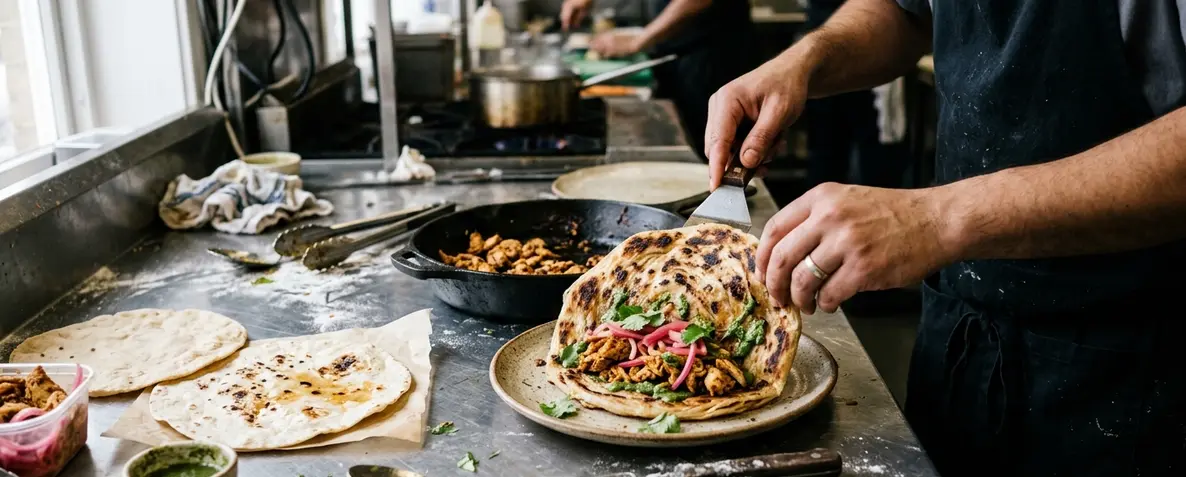
Layered paratha has the structural advantage here. Its laminated fat, thicker crumb, and crisp outer layers hold up to chutney, compression, and hot filling, plus a brief rest in foil. Thin roti bends easily but absorbs juices quickly. A standard flour tortilla stays flexible, although it lacks the flaky texture that defines the roll.
Use one 20–23 cm paratha in a 25–28 cm cast-iron skillet. The bread should lie flat so blistering happens across the surface rather than around a single hot spot.
Blister First, Add the Egg Second
- Preheat a dry or lightly oiled skillet over medium-high heat for 4–5 minutes.
- Cook the paratha for 45–60 seconds per side, stopping when brown blisters appear but the center remains pliable.
- Crack one egg onto the upper surface. Pierce the yolk immediately and spread it to roughly 1 cm from the edge.
- Let the egg begin setting for 20–30 seconds, then flip the paratha.
- Cook the egg side against the skillet for 30–45 seconds and remove the bread.
The egg creates a thin, savory barrier between bread and filling. Spreading the yolk matters: a thick patch in the center cooks unevenly and makes the first fold bulky. Count on about 2–3 minutes for the whole bread-and-egg stage.
Keep the Center Flexible
Deep blistering belongs on the surface, not all the way through the crumb. A rigid paratha cracks at the side folds and releases chutney onto the foil.
Build Kebab Character in a Hot Skillet
Boneless chicken thigh suits the fast, high-heat treatment because it retains moisture while the marinade browns. For one large roll, cut 150 g chicken into pieces no thicker than 2 cm. More exposed surface means more yogurt, spice, and skillet contact in every bite.
Combine the chicken with 30 g plain full-fat yogurt, 5 g ginger-garlic paste, 1/2 teaspoon each ground cumin and ground coriander, 1/4 teaspoon each garam masala and Kashmiri chile or mild ground chile, 1/8 teaspoon turmeric, and 1/4 teaspoon fine salt. Refrigerate for 30 minutes to 8 hours.
The yogurt performs two jobs. Its lactic acid gently tenderizes the thigh meat, while its proteins and sugars help form browned patches during cooking. Ginger, garlic, cumin, coriander, chile, turmeric, and garam masala provide the aromatic backbone.
A Six-Minute Sear With One Firm Boundary
Preheat the cast-iron skillet over medium-high heat for 4–5 minutes, then add 1–2 teaspoons neutral oil. Lay the chicken in one uncrowded layer and leave it undisturbed for 3 minutes. Turn the pieces and cook for roughly another 3 minutes.
The six-minute schedule applies to boneless thigh pieces no thicker than 2 cm. Confirm that the thickest piece reaches 74°C; temperature, rather than the clock, decides when the chicken leaves the pan. Rest it for 3 minutes before assembly.
Paneer and Mushroom Routes
Paneer brings a dense, milky bite that stands up well to the same spice profile. Cut 140 g paneer into 2 cm batons, marinate for 15–30 minutes, then brown each broad face for 1 1/2–2 minutes.
For a more savory vegetarian roll, coat 160 g thickly sliced portobello or cremini mushrooms for 10–15 minutes. Cook them for 6–8 minutes, allowing their moisture to evaporate before judging the color. They are ready when the edges look browned and the skillet no longer holds a watery pool.
Use Mint, Lime, and Onion to Sharpen the Roll
The condiments have one job here: balancing rendered chicken fat and the oil between the paratha’s layers. Quick-pickled onion provides acid and crunch, while a concentrated herb chutney carries freshness through the warm spices.
Pickle the Onion Before the Skillet Heats
Toss 25 g thinly sliced red onion with 10 ml lime juice or mild vinegar and a small pinch of salt. Leave it for 10–20 minutes, then drain it well. The edges soften during the short soak, but the center keeps its snap.
The onion is at its crispest between roughly 30 minutes and 4 hours after preparation. Draining matters as much as pickling; excess liquid runs toward the seam and weakens the bread.
Blend a Spread, Not a Pouring Sauce
For a small batch of chutney, blend 20 g cilantro leaves and tender stems, 10 g mint leaves, one small green chile, 10–15 ml lime juice, 1/4 teaspoon salt, and 15 ml cold water. Run the blender for 30–45 seconds, scrape the jar, then blend for another 15–20 seconds.
Add extra water only in 1-teaspoon increments. The finished chutney should cling to a spoon. A sealed batch keeps in the refrigerator for 1–2 days.
Use 1 tablespoon per roll, followed by about 1/8 teaspoon chaat masala at assembly. Kala namak, or black salt, gives the spice blend its characteristic sulfurous aroma and tangy street-style finish.
Roll From the Lower Third and Lock the Seam
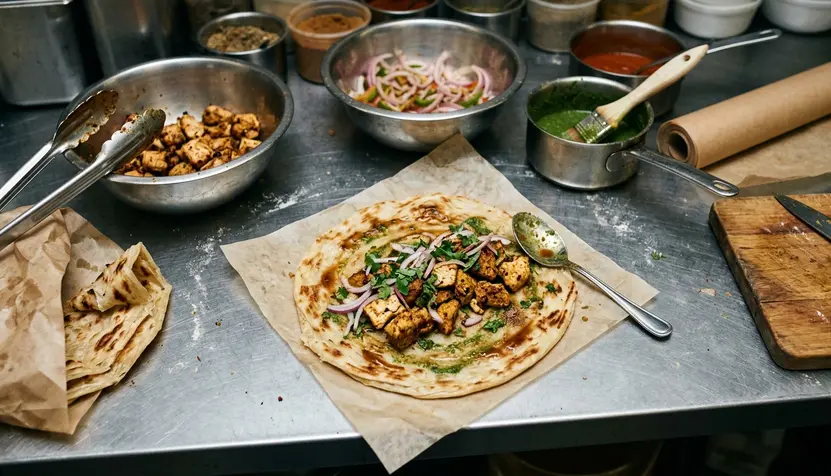
Assembly starts with the paratha egg side up. Spread 15–20 g chutney over the center, leaving a 2 cm dry border. A thin, even layer seasons more bites and avoids the slippery pocket created by a spoonful dropped in the middle.
Arrange 110–130 g cooked filling in a horizontal strip across the lower third. Stop 3–4 cm from each side, then top the protein with 20–30 g drained pickled onion and about 1/8 teaspoon chaat masala.
Tension Makes the Roll Portable
- Pull the lower edge over the filling and tuck it firmly underneath the strip.
- Fold both sides inward by 2–3 cm to close the ends.
- Roll forward in one tight motion while maintaining gentle pressure.
- Place the seam against the work surface so the bread settles around the filling.
Wrap the lower two-thirds in a 25 cm sheet of foil. The foil holds the cylinder together, traps residual heat, and softens the crisp paratha just enough for comfortable eating. Leave the upper third exposed so steam can escape instead of collecting around the first bite.
Hold the wrapped roll seam-side down for a minute or two. That short pause lets the bread conform to the filling and gives the folded edge time to stay closed.
An 18-Minute Chicken Kati Roll to Copy Tonight
This single-roll plan overlaps heating, pickling, resting, and bread preparation. Begin with 150 g chicken thigh that has already marinated for at least 30 minutes.
Minute-by-Minute Build
- Minute 0: Remove the marinated chicken from the refrigerator. Set a cast-iron skillet over medium-high heat. Toss 25 g sliced red onion with 10 ml lime juice and a pinch of salt.
- Minutes 4–7: Add 1–2 teaspoons neutral oil to the hot skillet. Spread the chicken in one layer and sear it untouched for 3 minutes.
- Minutes 7–10: Turn the chicken and cook for roughly 3 minutes. Check the thickest piece for a 74°C center, then transfer all the chicken to a plate.
- Minutes 10–11: Place one 20–23 cm paratha in the skillet. Cook for 45–60 seconds until the underside blisters.
- Minutes 11–13: Flip and blister the second side for 45–60 seconds. The chicken rests during this window.
- Minutes 13–14: Crack one egg onto the paratha, pierce the yolk, and spread it toward the edge. Let it set for 20–30 seconds, flip, and cook the egg side for 30–45 seconds.
- Minutes 14–16: Set the paratha egg side up. Spread 1 tablespoon thick cilantro-mint chutney across the center, keeping a 2 cm border. Add the rested chicken across the lower third, drain the onions, and scatter them over the meat. Finish with 1/8 teaspoon chaat masala.
- Minutes 16–18: Fold the lower edge over the chicken, tuck both sides inward, and roll forward tightly. Enclose the lower two-thirds in foil and rest it seam-side down for a minute or two.
At minute 18, lift the foil-wrapped roll with the open end upright. The first bite should move through crisp-edged paratha, warm egg, charred chicken, cold herb chutney, and lime-bright onion in that order.