Steaming Espresso, Cold Ski Boots, and the Midday Verdict
Picture an imagined midday pause just off Main Street in Breckenridge: stiff ski boot buckles popped loose on a snow-dusted wooden porch, a warm paper bag holding a flaky ham-and-gruyere croissant in one hand, and a cluster of hungry skiers gathering outside a busy tavern across the street. That contrast captures the central dilemma of mountain dining on a ski day.
Choosing a bakery counter over a full-service dining room trims the ordering and payment cycle, though the complete ski-to-town round trip dictates whether you actually gain extra runs on the hill. Rather than assuming a pastry stop automatically saves a full hour of slope time or slices a lunch budget in half, compare the difference against your own receipt and watch.
Evaluating how quickly a midday meal gets you back onto the snow requires a single, strict metric: the racks-to-lifts clock. That timer starts the exact moment your skis slide into the base-area rack and stops only when you step back into the lift queue. A realistic calculation must capture every transition in between:
- Walking in ski boots from the snow to the shop entrance
- Waiting in the counter queue and placing the order
- Eating the meal and drinking your coffee
- Making a quick restroom stop
- Walking back, retrieving equipment, and buckling boots
When you measure the full sequence, a town bakery run is rarely a twenty-minute affair. A sample itinerary from the lower mountain into town and back budgets approximately 45 minutes from rack to lift.
Savory Pastries That Outperform Lodge Burgers on the Slopes
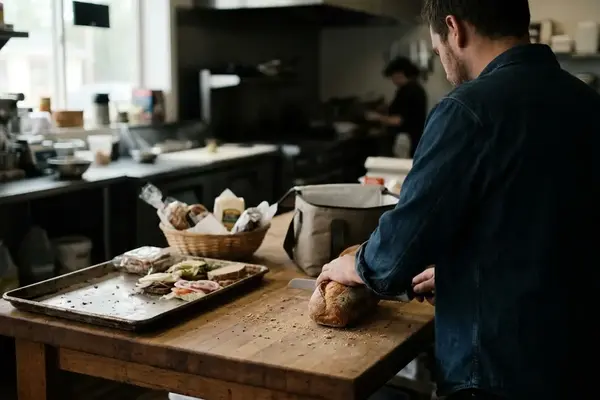
Evaluating ski-day comfort food comes down to portion size, filling composition, and how well an item travels from a display case to a cold bench. When scanning a pastry counter for a substantial bite, four savory formats stand out for a midday break: a sausage-stuffed kolache, a green chile cheddar scone, a thick quiche wedge, or a crusty sourdough focaccia sandwich.
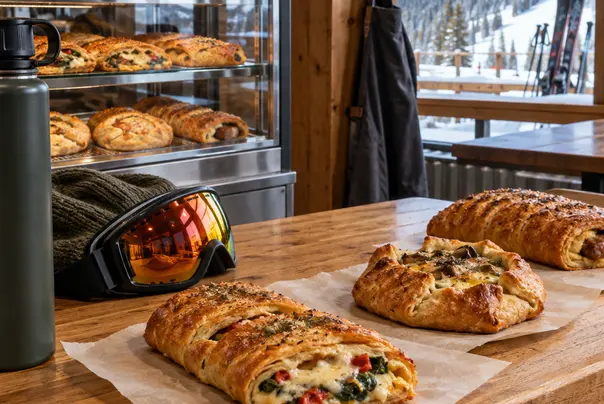
Understanding what each option actually puts in your tank helps set realistic expectations for the afternoon runs. Eggs, cheese, cured meats, and beans supply welcome protein, while laminated doughs, biscuit batters, and bread crusts deliver carbohydrates alongside substantial culinary fat. A cheddar scone is not automatically a high-protein athletic meal, and a butter-laminated croissant is not inherently lighter on the stomach than a classic lodge burger. Because dietary fat generally slows gastric emptying, neither high elevation nor a warm roasted filling guarantees that a pastry will prevent afternoon lethargy or supply steadier energy than a traditional lunch plate. Instead, the practical advantage of a bakery stop lies in portion control: you can select a single palm-sized bake that satisfies hunger without committing to a massive platter of fries.
Packaging and Crust Mechanics in Cold Air
How a bakery wraps your food dictates whether that pastry stays appetizing once you step outside. A breathable paper bag or a lightly vented wrapper allows steam to escape, protecting a flaky crust from turning soggy through condensation. Sealing hot food inside a tightly closed plastic container traps moisture immediately, softening crisp layers within minutes. Slipping a wrapped snack into an insulated jacket pocket holds onto warmth for the chairlift, though it sacrifices crispness along the way.
Midday Pastry Strategy: During an 11:25 to 11:50 AM eating window, pick a manageable savory portion and eat the hot item first while the crust is crisp. Keep your afternoon cookie wrapped separately so stray savory crumbs and melted cheese never mix with your pocket dessert.
Counter Lines, Boot-Friendly Seating, and the Real Cost Breakdown
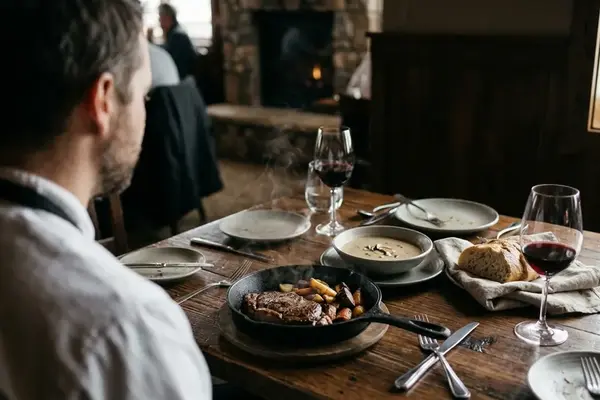
Comparing a bakery counter against a sit-down restaurant requires separating service time from travel time and auditing the complete receipt. At a table-service restaurant mid-mountain or in town, the clock absorbs several distinct phases: waiting at the host stand, reviewing menus, waiting for the kitchen to fire entrées, and flagging down a server to settle the check. Counter service condenses ordering and payment into a single transaction at the register, though individual kitchens and cafés move at their own pace.
To test when town queues move fastest, treat 10:45 to 11:15 AM and 1:30 to 2:00 PM as candidate observation windows on your next trip. If you aim for a late-morning stop hoping to catch a second oven pull of warm scones or bread somewhere around 10:45 AM, ask the counter staff directly that morning, as baking schedules and sellout times shift from shop to shop and day to day.
Auditing the Midday Receipt
Whether a bakery run cuts your dining budget depends on a like-for-like receipt comparison. Add up the two columns side by side on your own trip:
- The Bakery Ledger: One savory pastry or focaccia sandwich + one espresso drink + one optional pocket cookie + local tax + counter tip.
- The Sit-Down Ledger: One plated entrée + one beverage + local tax + full-service gratuity.
Boot-Friendly Seating and Gear Logistics
Before paying at a tight town café, scan the room for actual boot-friendly logistics. Check the entrance threshold, aisle width, equipment storage rules, and open chairs before committing to the line. When recording seating options, treat indoor tables and outdoor patios as separate categories. Bright winter sunshine does not guarantee that an outdoor deck is heated, cleared of snow, or open to passersby who have not bought food from that specific establishment.
Once you claim a spot, manage your gear with care. Keep your helmet and damp gloves tucked together inside a daypack or designated storage cubby rather than spreading them across an extra chair in a busy dining room. Always leave interior walkways and emergency exits completely clear of skis, snowboards, and poles.
Sub-Zero Whiteouts and Group Days: When a Full Sit-Down Lunch Still Wins
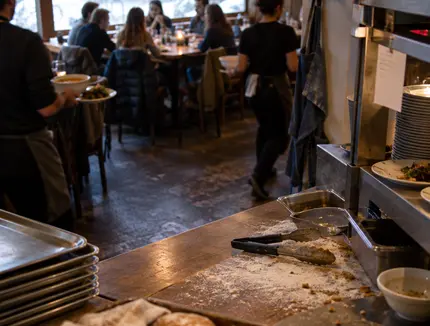
The pastry-bag plan has its limits: a sub-zero bench, six diners without confirmed seats, or gluten-free preparation without verified cross-contact controls. When shelter, coordinated group seating, or strict food handling matter more than a quick counter transaction, a confirmed sit-down lunch wins outright.
1. Severe Cold and Whiteout Conditions
When mountain thermometers drop below 0°F (approximately −18°C), or when high winds and whiteout snow sweep across the peaks, sitting on an exposed outdoor bench with a paper bag ceases to be enjoyable. In severe weather, prioritize reliable indoor shelter. Blocking out 45 to 60 minutes inside a warm dining room over a bowl of hot soup gives your group a substantial itinerary break to thaw out—treating that hour as a practical scheduling buffer rather than a medical recovery protocol for cold exposure.
2. Coordinating a Six-Person Crew
Solo skiers and pairs slip easily into single counter stools, whereas larger groups face seating bottlenecks. If you are skiing with a party of six or meeting non-skiing family members in town, hovering over cramped café tables with trays of flaky crumbs creates unnecessary friction. Confirming a reservation for six seats together at a full-service restaurant keeps the group intact and relaxed.
3. Strict Gluten Avoidance
A glass pastry case dusted with airborne wheat flour poses obvious challenges for anyone who requires strict gluten-free food handling. However, simply choosing a table-service dining room is not automatic proof of a dedicated gluten-free kitchen. When dining with someone who must avoid gluten strictly, speak directly with the restaurant staff to verify whether they maintain separate preparation surfaces, dedicated utensils, isolated storage, and independent cooking equipment to prevent cross-contact.
The 11:15 AM Peak 9 Run: A Step-by-Step Bakery Break Blueprint
To test this midday strategy on your next Breckenridge trip, copy this proposed 45-minute itinerary starting from lower Peak 9. The Quicksilver racks-to-lifts ledger: outbound boot walk, counter queue, croissant and Americano, bench time, and the return to bindings all belong inside the 11:15 AM–noon break. Before clicking into your skis in the morning, confirm daily trail and lift operating status, and scout your exact pedestrian route and bakery entrance in advance so you never waste minutes wandering in ski boots.
- 11:15–11:25 AM (Base Arrival and Outbound Walk): Cruise down an open lower Peak 9 trail to the base area near the Quicksilver SuperChair. Slide your skis and poles into an authorized rack at the village edge, start your watch, unbuckle your top cuffs for walking comfort, and follow your pre-checked pedestrian route toward your chosen bakery counter.
- 11:25–11:35 AM (Counter Queue and Order): Step inside and allocate ten minutes as your target window for ordering and collection. Order one available hot savory bake (such as a ham-and-gruyere croissant, sausage kolache, or cheddar scone), one separately wrapped cookie for the afternoon lift ride, and a hot Americano.
- 11:35–11:50 AM (Confirmed Seating and Refuel): Sit down at your confirmed indoor table or open bench, tucking your helmet and gloves neatly under your seat. Eat the warm savory pastry first while the vented paper bag keeps the crust crisp, enjoy the Americano, and zip the wrapped cookie into a secure jacket pocket so it stays intact for later.
- 11:50 AM–12:00 PM (Return Walk and Lift Queue): Use the final ten-minute block to walk back to the base area, clear snow from your boot soles, lock back into your bindings, and glide directly into the Quicksilver SuperChair lift queue right as the noon bell hits.