Wrapping food is an exercise in applied physics. Every handheld meal requires a delicate balance between the moisture of the filling and the structural integrity of the dough holding it together. A perfectly spiced breakfast taco or a rich, braised short rib loses its appeal the moment the wrapper disintegrates, sending hot juices running down a diner's wrist. Structural strength and moisture-wicking capacity determine the best wrapper for any given dish. Matching the right dough to the right filling ensures the food arrives at the palate exactly as intended.
Structural Engineering Under a 90-Gram Load
To set a baseline for wrapper durability, you need a consistent stress test. Subjecting different doughs to the exact same load highlights their physical limits. A useful working test uses about 90 grams of filling plus 15 milliliters, or 1 tablespoon, of sauce per wrapper. That ratio mimics the reality of a generous street food portion, providing enough weight to test the tensile strength and enough liquid to challenge the crumb.
Checking the assembled wraps at intervals shows how structural failure unfolds. Cooks look at each wrap immediately and again at 5 and 10 minutes for seepage, tearing, and loss of grip. Inspecting the bottom seam, the primary fold, and the eating edge provides a clear picture of how the dough handles the stress.
Three groupings emerge. Sticky glaze favors bao, because the soft crumb supplies a necessary textural contrast. Oily, relatively dry fillings favor tortillas, which handle fats exceptionally well. Braised meat with spoonable sauce favors thicker flatbreads capable of absorbing heavy moisture without collapsing.
Glaze, Steam, and the Bao Crumb
Steamed dough creates a unique high-moisture environment. The pillowy texture of a bao bun relies on a delicate, aerated crumb that reacts instantly to introduced liquids. The bao pairing is decided by checking whether the filling carries a glaze that clings to a spoon. Caramelized pork belly or sticky mushrooms pass that test because most of the liquid stays on the food itself, interacting with the dough only at the surface level.
Add a free-flowing broth to that environment and the structure fails almost at once. Thin liquids travel rapidly into the steamed crumb, soften the hinge, and make the bun difficult to lift cleanly. The dough transforms from a fluffy contrast into a soggy paste.
Managing Condensation Windows: Portion 50 to 60 grams of cooked filling into a standard folded bao so the hinge can close without compression. Steam chilled bao with cooked filling for 6 to 8 minutes, then uncover the basket promptly and serve within about five minutes to limit condensation on the surface.
The timing ranges assume palm-size bao filled with already-cooked ingredients; larger buns and raw meat fillings require recipe-specific cooking and temperature checks. Getting the steaming and serving window right is what keeps the bun's signature texture intact from the bamboo basket to the first bite.
Heat and Tensile Strength in Corn and Flour
A cold tortilla only tells you about its storage stiffness. To judge service performance, heat each tortilla until flexible before adding the filling, fold it once, and watch the crease. That bit of heat changes the mechanics of the dough entirely.
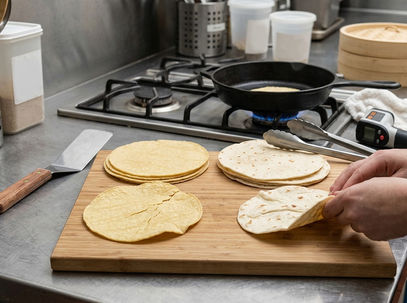
Flour tortillas offer superior tensile strength. The gluten network stretches effortlessly around wet salsa, containing the moisture within a thin, durable barrier. Corn tortillas provide a much stronger toasted-corn flavor, elevating the overall profile of the dish. They do, however, suffer from rapid moisture migration when exposed to loose liquids.
To compensate for that vulnerability, cooks warm a 6-inch corn tortilla for 20 to 30 seconds per side on a dry skillet, then stack two for fillings carrying loose salsa or meat juices. Double-stacking lets the inner tortilla absorb the initial moisture shock while the outer tortilla maintains the structural hold.
Prep time remains minimal, making tortillas the most efficient choice for high-volume, quick-turnaround meals. For quick service, cooks portion roughly 60 to 85 grams of filling and eat wet assemblies inside a three-to-five-minute window. Past that, even a double-stacked corn tortilla begins to lose its grip.
Thick Crumb Dynamics for Braised Fillings
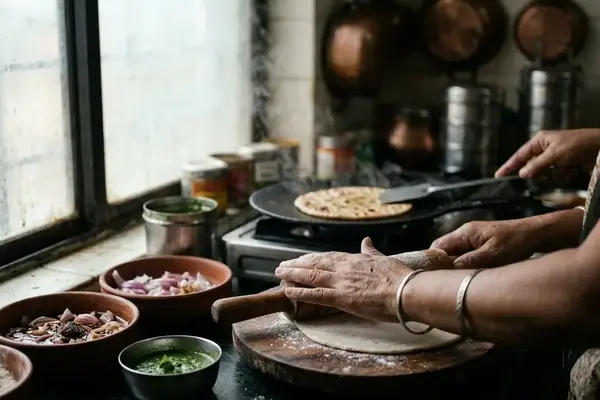
Flatbread selection starts with the weight and flow of the filling. Varieties like naan, pita, and roti feature the thickest crumb and highest durability, earning them the heavy-lifter role in the kitchen. They are the best choice for heavy curries, rich stews, and expansive party-style street food spreads.
A cook spreads sauce across the center, places the braised component over it, and folds without squeezing. The thicker crumb absorbs the first film of sauce while the outer face remains dry enough to hold. That split between a wet interior and a dry outer face keeps the diner's hands clean while delivering a fully sauced bite.
Party Spread Holding Tactics: Test a hand-size flatbread with 100 to 140 grams of braised filling, leaving a dry border of roughly 25 to 40 millimeters for gripping and folding. For a party spread, inspect assembled samples at 10, 20, and 30 minutes; keep extra sauce beside the platter rather than spooning it over every portion in advance.
Sturdier structure means they can sit out longer without going soggy. Keeping the extra sauce on the side also lets guests set their own moisture level right before eating, which preserves the flatbread's durability throughout the event.
The Breckenridge Short-Rib Boundary
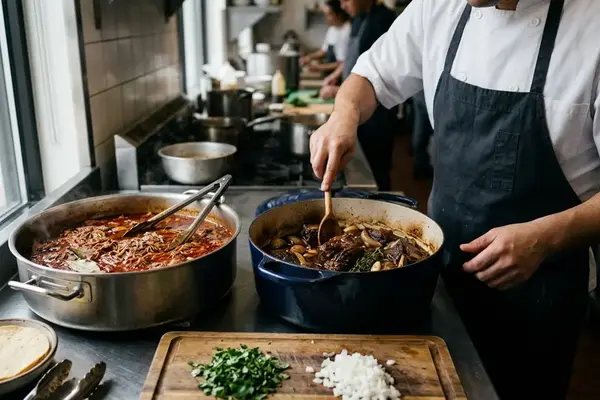
During a late winter service in Breckenridge, the kitchen operates at a relentless pace. The ambient air is dry and cold, and the tickets demand heavy, warming comfort food. A cook stands at the pass, lifting a portion of braised short rib from the holding pan. The reduced braising sauce follows the meat in a slow, glossy ribbon, clinging to the spoon before pooling onto the cutting board.
A tortilla is ruled out at that single point, because the portion is both heavy and wet. The cook grabs a thick flatbread and chars it on the plancha for 20 to 30 seconds per side, watching the surface bubble and take on dark, toasted spots. They assemble the wrap with 110 to 130 grams of drained short rib and 15 to 20 milliliters of the reduced braising sauce, laying the meat slightly off-center.
Working quickly, the cook folds the thicker edge underneath, building the wrap in about a minute. The plate is handed to the runner. Over the two-to-four-minute pass-to-table interval—a compact dining room, not a long buffet hold—the transformation begins. The interior crumb of the charred flatbread absorbs the rich, beefy sauce, swelling slightly, while the toasted exterior stays dry and firm as it lands in front of the guest.